The Pelvic Self
Designing a trusted way to find pelvic floor care
Summary
This case study is a summary of highlights taking The Pelvic Self from 0 → 1. I’m happy to walk through the full research and decisions on a call.
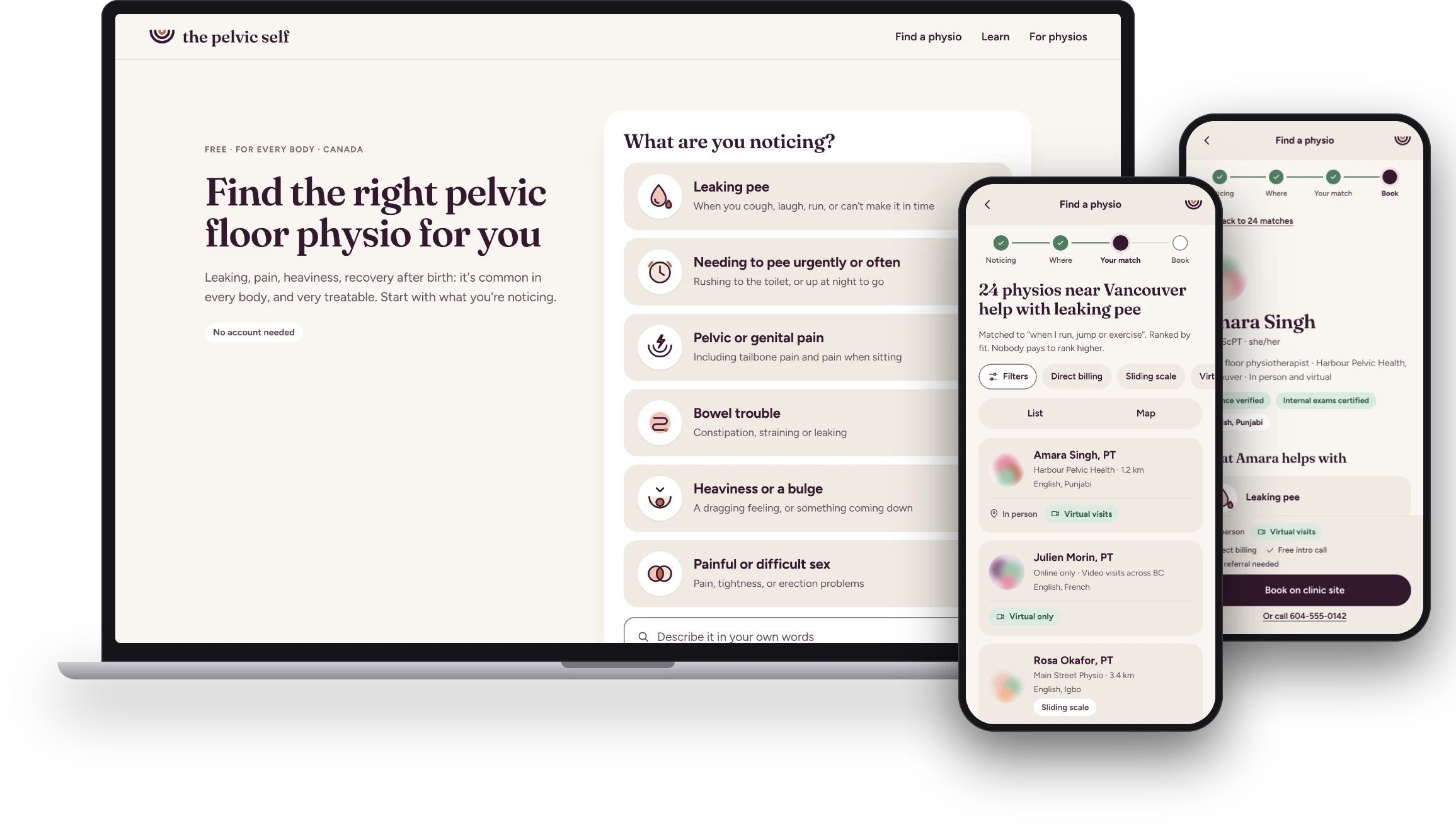
Pelvic floor physio helps with leaking, pain and prolapse, but most people never get care, and those who look can’t tell which physio treats what. The Pelvic Self matches people to physios by what they’re noticing, in their own words.
I led the research, product strategy and design of all three parts: patient search, the physio portal and the admin console (what should we build? Why? In what order?). The Pelvic Self is my own product, which let me take it from first research to launch.
Introduction
In Canada, about 3.3 million people live with bladder leakage, and only about a quarter of people with a bladder problem have talked to a health professional about it. The treatment works. The gap is access. We started with three goals.
First, help people find care in their own words. The language around pelvic health is clinical. Search had to start with what people notice and lead to a physio who treats it.
Second, give physios a reason to be here. A directory is only as good as its listings. Physios needed something worth claiming: a listing they control, and free insights their booking software can’t give them.
Third, stay trustworthy and free. Listings are checked against the BC register, nobody pays to rank higher, and the site is funded by combined, anonymous trends, never anything that identifies a person.
Defining and researching the problem
I started with a survey about pelvic floor care: who’s seeing a physio, how long they waited, how they paid and what’s in the way. Then I put early screens in front of patients and physios.
Within minutes of the first test, someone asked whether the clinic had a step-free entrance. Neither the survey nor the physio setup had asked about access. So testing started shaping the survey, not the other way round.
People describe what they notice, like leaking when they run. Directories list diagnoses.
One question in testing, about a step-free entrance, changed the survey, the filters and the physio setup.
Affordability came up in interviews with women with endometriosis. Some physios offer a sliding scale but rarely say so.
stress urinary incontinence
“I leak when I run.”
So the search starts with their words, not ours.
Mapping the riskiest assumptions
A marketplace has two sides, and both have to show up. I mapped what we believed about patients and physios, and sorted each belief by how much we knew and how risky it would be to get it wrong. The riskiest ones got tested first.
Forming a hypothesis and defining success
How might we create a world where:
- People can find a pelvic floor physio in their own words
- Physios are found for what they’re actually trained in
- Nobody has to guess whether a physio can help them
Success had to be something the whole product could be measured against, on both sides of the marketplace:
- The north star: the share of searches that end in a booking click or a call
- Physios who claim their listing, and come back to Insights each month
- Time from first search to booking click
The Pelvic Self is launching in British Columbia. Results will be added here.
Prototype, test, repeat
I tested search, results and listings with patients, and the claim flow with physios, changing the product between rounds. As we learned, I formed a point of view that now runs through the product:
- Plain words first. Clinical terms come second, if at all.
- Blanks say “not stated”, never “no”. We don’t guess.
- Nobody pays to rank higher. Results are ranked by fit.
- Nothing goes live that needs a physio to review it first.
One plain question, then matches
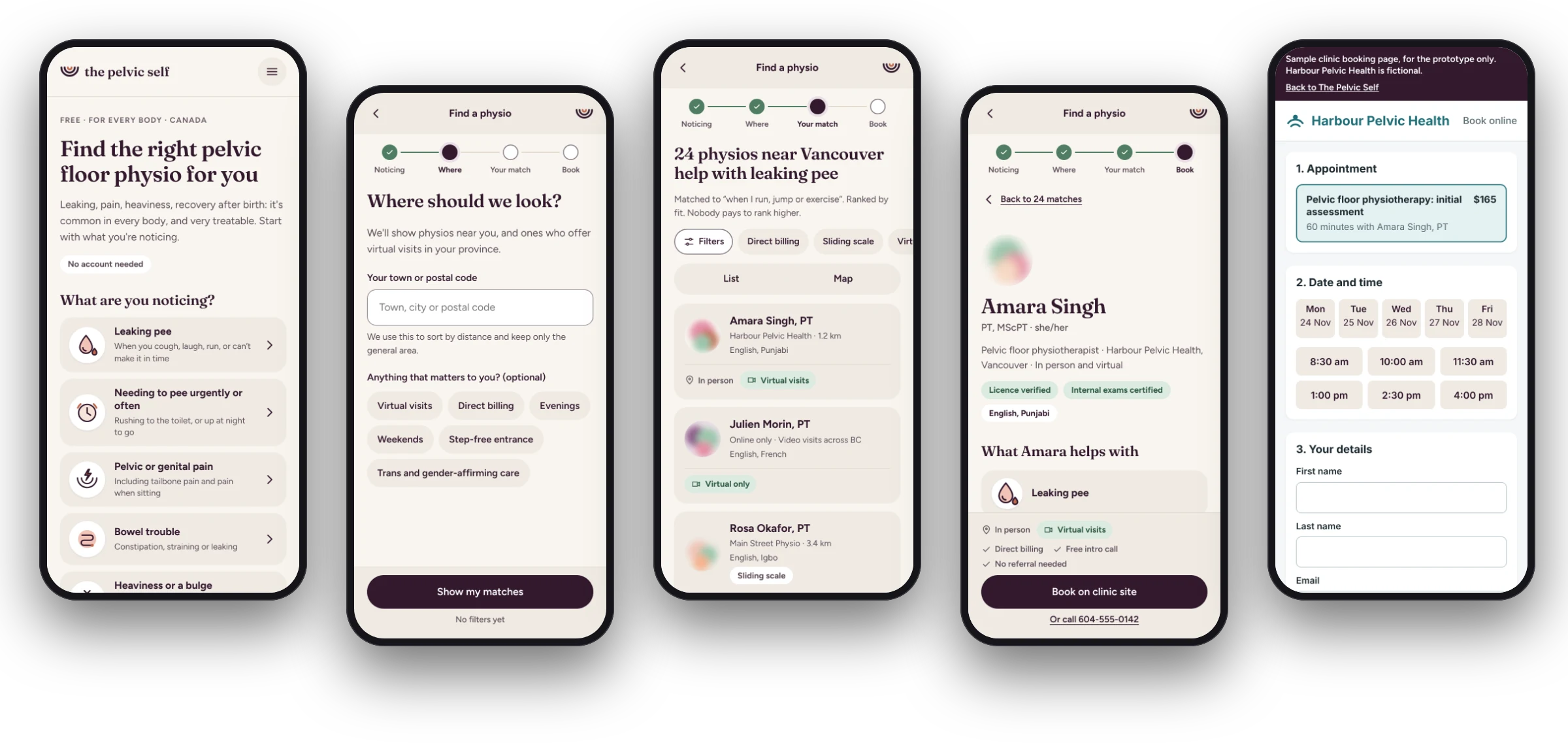
One tap narrows "Leaking pee" to when it happens, with an "I'm not sure" option.
Search in their words
The hardest problem was the first question. People don’t know what their condition is called, and many are embarrassed to ask. Search starts with “What are you noticing?” in plain words, ordered by how common each concern is, with an “I’m not sure” option. People can also write it their own way, and we match it to what physios treat.
Everything else lives in Filters, one tap away, so the first step stays short. Live counts show how many physios match before anyone commits.
Filters update the count as you tap
Evenings and direct billing narrow 24 physios to 12 before you commit.
A physio portal worth coming back to
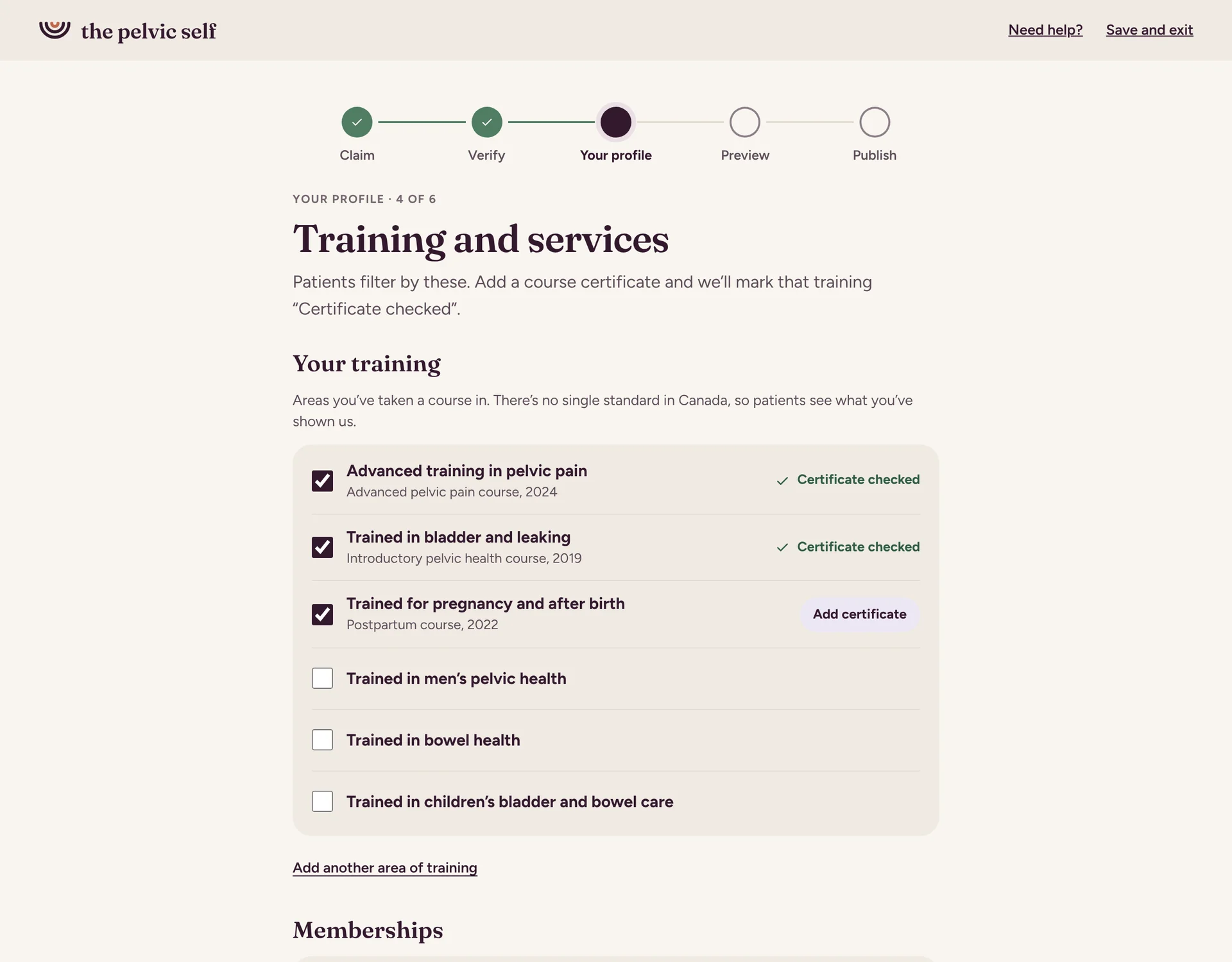
Physios are busy, so claiming a listing had to feel like checking, not typing. A physio finds their draft, we confirm their licence and internal exam certification on the BC register, and six short steps follow, mostly prefilled from public sources.
In Canada there’s no single standard for pelvic health training, so patients can’t tell who has trained beyond the basics. Physios list their training and memberships, and adding a certificate marks it “Certificate checked”. Patients can filter by it, so every new course gets a physio found for more.
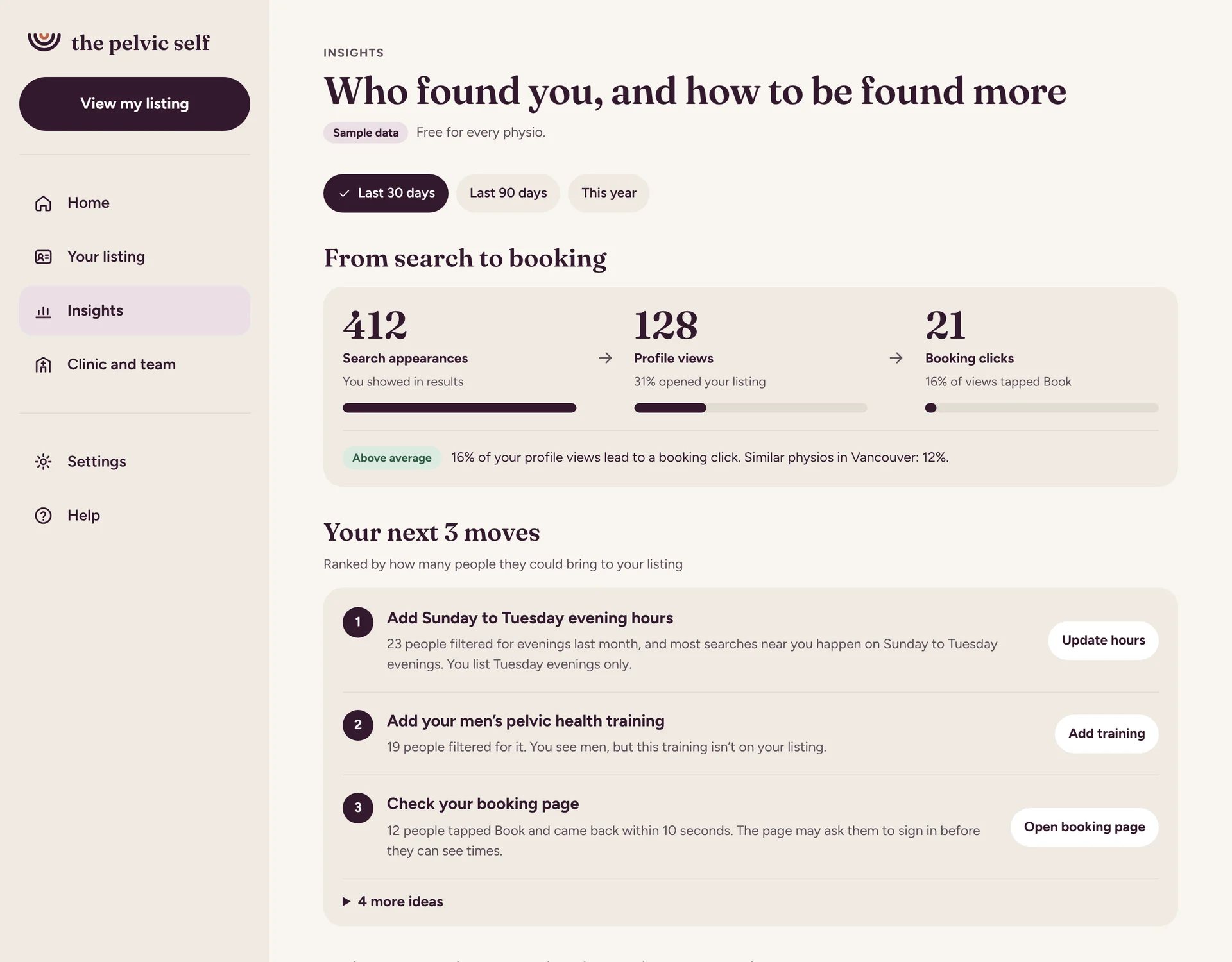
Insights are free. Instead of charts, each physio sees who found them and their next three moves, each backed by real demand: add evening hours, add a training, fix a booking page that loses people.
A directory that keeps itself right
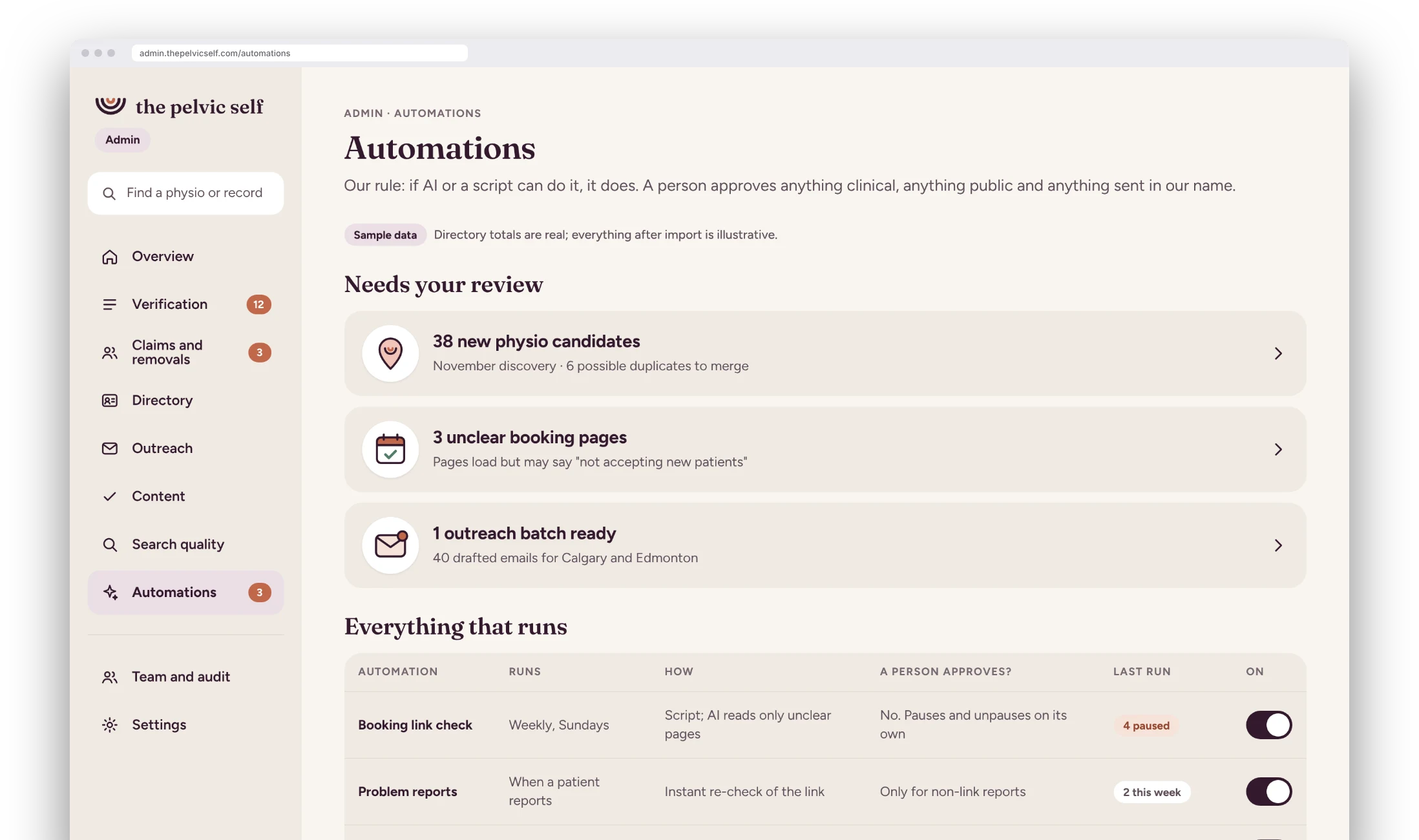
A directory is only useful if it’s accurate. The admin console runs on one rule: if a script or AI can do it, it does, and a person approves anything public, clinical or sent in our name. Licence re-checks, broken booking links and stale hours are caught automatically, and a listing pauses itself rather than sending patients to a dead end.
Designed for every state
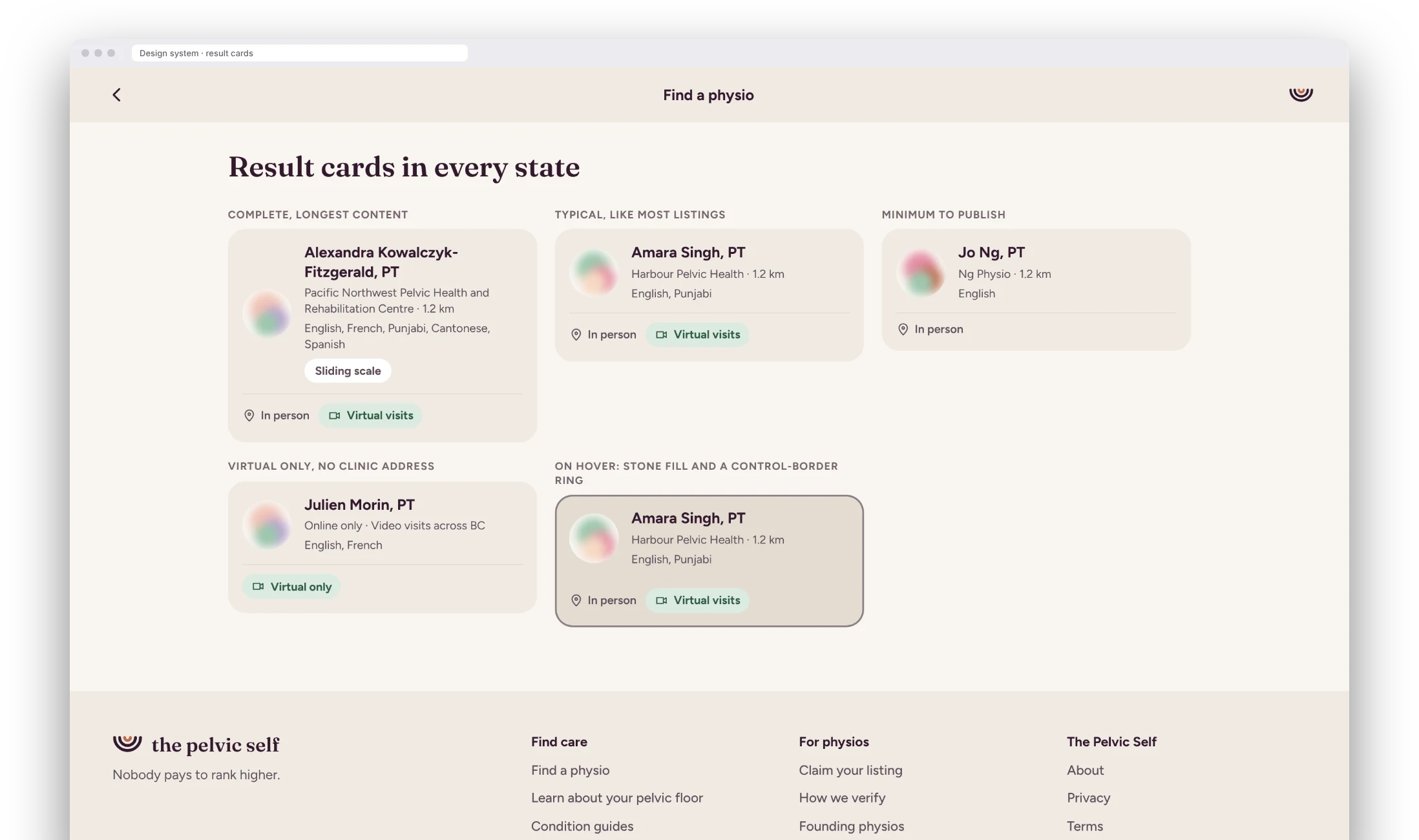
Real listings vary from a single line to five clinics and nine insurers, so I designed every component for its longest, typical, minimum and empty states, across mobile, tablet and desktop. Result cards follow one rule: how you can be seen always reads left to right, in the same order, so the eye never has to search.
The design system uses warm paper and fig tones instead of clinical blue, with every colour pair checked for contrast.
Figtree for reading
- Fig
- Paper
- Clay
- Sage
- Blush
- Mint
Why British Columbia first
Physios are regulated provincially, so every licence check is built and tested one regulator at a time. Search also only works when there’s someone near you, and going deep in one province fills results sooner. Everything that changes by place lives in one region profile, so a new province is a new profile, not a new product. The goal is a tool for anyone, anywhere.
What I loved working on
- Turning clinical terms into plain words.Writing the concern list was part design, part translation.
- Saying “not stated” instead of guessing.Honest blanks turned out to be a trust feature.
- A directory that keeps itself right.Scripts and AI do the checking. A person approves what goes public.